
About Silk Lineage
My grandmother, Wu Chengyu (伍成玉), is eighty-nine. She learned to sew as a child and worked as a tailor her whole life, making clothes for other people. Chanhua and ronghua were never her trade — they were what she did with the time that was left. When there was spare thread, she wound it into hairpins and clips for us. When a garment wore through, she covered the hole with a flower, and the mended place became the best part of it.
I did not learn as a child. I started after university, while I was already working, and I spent six years learning beside her. I am Hu Yonghong (胡永红).
The work I almost left behind
After university I moved to Guangzhou and took an ordinary job. By most measures it was a good life. But I kept noticing that nothing in it felt the way it felt to sit beside my grandmother and make something with my hands. That quiet. That patience. The small satisfaction of finishing a petal and watching it hold its shape.
She is eighty-nine now. At some point I understood that if I did not pick it up, no one in our family would. So I asked her to teach me. Six years later I started Silk Lineage to keep the craft — and to hand it on.
What Chanhua and Ronghua actually are
Chanhua and Ronghua are flowers made of thread and silk, wound by hand around a wire skeleton. They are not printed and not moulded. No machine makes them.
Chanhua is a folk craft that joins three older skills: paper-cutting for the petal shapes, weaving for the structure, embroidery for the surface. Its techniques have their own names — winding, twisting, coiling, folding, binding. For generations these flowers were made for the days that mattered: bridal hair ornaments, temple offerings, gifts between families. In the Minnan dialect of southern China, one of the old names for Chanhua sounds like the word for surplus — a wish for more than enough, year after year.
Ronghua is the softer cousin. It is built from degummed silk rather than thread, so the finished flower carries a fine, downy surface and reads almost like a living bloom. Its name sounds like the Chinese words for prosperity and honour, which is why it was worn at New Year and on joyful occasions.
That is what these flowers have always been. Wishes, made by hand, in a form you can keep.
Why it takes so long
A simple Chanhua piece takes four to six hours. A complex one can take a month.
I work with mulberry silk. My grandmother's generation raised silkworms and reeled the thread themselves; today I work with specialist silk workshops so that colour and quality stay consistent from one piece to the next. The same care goes into the copper wire and, when a piece calls for it, the mother-of-pearl shell used in Luodian inlay.
Everything is made by hand in my studio in Guang'an, Sichuan.
What I hope you feel
I am not really trying to sell you a hairpin.
I am trying to pass on what my grandmother passed to me — something quiet, made slowly, by a person rather than a process.
If you make it yourself, I hope you lose track of time. If you give it to someone, I hope they understand that what you are handing them is hours of a person's attention.
And I hope it lasts long enough to be passed on again.
Founder, Silk Lineage · Guang'an, Sichuan
The makers behind the work
Every piece we sell is made by a named craftsperson. These are the people whose hands you are buying.
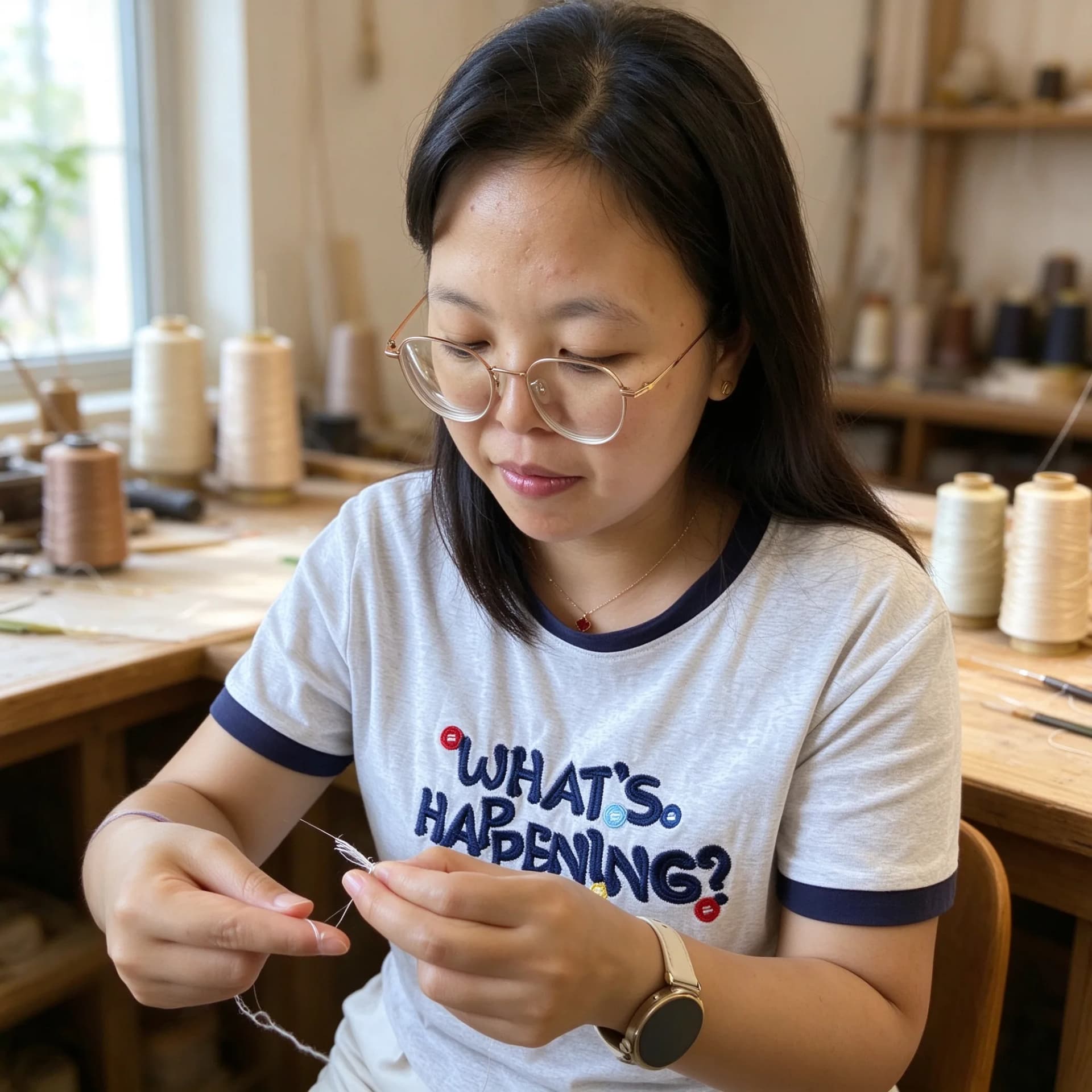
Hong红
Chanhua & Ronghua · maker
I'm Hong. I make Chinese silk flowers by hand in Guang'an, Sichuan — Chanhua and Ronghua, the two crafts my grandmother taught me over six years. She is eighty-nine now and has made these flowers since she was a girl. I left the craft for an office job in Guangzhou, missed the quiet of making something with my hands, and came back. Now I do this full time, and every piece in this shop is wound by me.
Guang'an, Sichuan