
The maker
Yonghong Hu
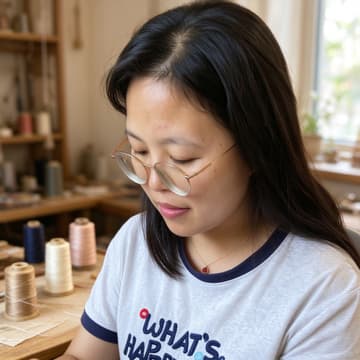
Yonghong Hu is the founder and maker behind Silk Lineage, a studio in Guang'an, Sichuan. She has worked in chanhua for six years and is now extending the studio into ronghua, the velvet branch of Chinese silk-flower work.
Every piece is made by hand from dyed silk and copper wire. A simple finished flower takes four to six hours; the most complex pieces take close to a month of evenings. The hours recorded on each product page are the studio's own, not an estimate.
Her own account of the craft is plainer than most: chanhua and ronghua are not hard to understand. You look at a petal, you see how the silk is wound, and then you do it with your hands. What separates a first attempt from a good piece is repetition, not talent.
The articles on this site are written with her, from the work on the bench: what a petal does when the wire is too soft, which colours hold in winter light, how long a piece really takes. Where a claim cannot be checked, it is left out rather than dressed up.
A family that sewed
My grandmother, Wu Chengyu (伍成玉), is eighty-nine. She learned to sew as a child and spent her working life as a tailor, making clothes for other people. Chanhua and ronghua were never her trade — they were what she did with whatever time was left. Spare thread became hairpins and clips for us. A hole in a sleeve became a flower, and the mended place ended up the best part of the garment.
I grew up with that, and I am Hu Yonghong (胡永红). What I want now is quieter than a business: to make these two crafts well, and to hand something beautiful to the next person.
Articles by Yonghong Hu
- A Christmas Table Setting With Silk Flowers
The rule for a Christmas table is the same one that governs a tree: keep the flowers low, keep them few, and keep them away from the candles. Here is a setting that works for six, eight or ten people.
- What Hair Accessory Goes With a Qipao?
The qipao already does the work of a necklace, so the hair is where the decision is made. One flower, set low, beats a full set of ornaments - here is how to choose it by collar height and hairstyle.
- How to Photograph a Silk Flower With a Phone
A hand-wound silk flower is one of the hardest things to photograph on a phone, because the thing that makes it beautiful - the sheen - is the thing a flash destroys. Here is the ten-minute setup that fixes it.
- Silk Flowers on a Christmas Tree: A Styling Guide
Five to nine silk flowers will do more for a tree than a box of baubles - if they are placed in the right three spots. Here is where they go, how to fix them without marking the branches, and what to do with them in January.
- How to Tell Handmade Silk Flowers From Machine-Made (7 Checks)
Six of the seven differences are visible in ten seconds if you know where to look - the thread lines, the petal edge, the back of the piece. The seventh is the price, and it is the most reliable of all.
- How to Wear a Silk Flower Brooch: Six Placements (and Three Mistakes)
A brooch is the one piece of jewelry that works without a hairstyle, a neckline or a size. Here are six placements that look deliberate, the three that do not, and how to stop a pin marking a delicate fabric.
- Ronghua Hair Flowers for Hanfu: How to Match Velvet to Your Outfit
Ronghua is matte where chanhua is glossy, and that one difference decides which outfits it suits. Velvet is the quieter choice against patterned fabric, and the denser one for formal robes.
- Wedding Boutonnieres and Corsages: A Handmade Chinese Alternative
A boutonniere for the groom and a corsage for the bride are two different things in English, and at a Chinese wedding they are usually worn as a matching pair in red. Silk flowers do not wilt by the next morning.
- What to Wear to a Christmas Party: One Silk Flower Hairpin, Three Outfits
A silk flower hairpin is the cheapest way to turn an outfit you already own into something that looks deliberate. Here are three formulas, and where exactly to place the pin.
- What Is a Buyao? The Chinese Hairpin That Moves
A buyao is a hairpin with dangling beads that sway as the wearer walks. The movement was the point: it marked a person moving slowly and formally, and it is why brides still wear them.
- Silk Flower Hairpins for Short or Fine Hair
A single hair stick needs hair to pass through, which is why it slides out of fine hair. Here is what actually holds - forks, combs, small buns and brooches - and how much weight to avoid.
- What to Buy Someone Who Loves Hanfu
Hanfu wearers do not need another robe. What they cannot buy enough of is ornaments that match the outfits they already own - and that is the gift that lands.