Silk Flowers on a Christmas Tree: A Styling Guide
How do you use silk flowers on a Christmas tree?
Clip them to the branches. A silk flower with a wire stem or a brooch pin sits on a tree the same way a bauble does: bend the stem around a branch, or pin the flower to a ribbon loop tied on. Most trees need far fewer than people expect - five to nine flowers, in three loose groups, not a flower on every branch.
The reason to use them at all is scale. A bauble is a sphere; a hand-wound flower has petals, a center, a stem and a shadow, and it holds detail at the distance a person actually stands from a tree. It also costs more per piece than anything else on the tree, which is exactly why it should be used sparingly.
Why silk rather than fresh flowers?
Because a Christmas tree stands in a heated room for a month, and that is the one condition fresh flowers handle worst. Carnations and chrysanthemums will hold for a week if the stems sit in water; on a dry branch, in moving warm air, most flowers are tired by day four.
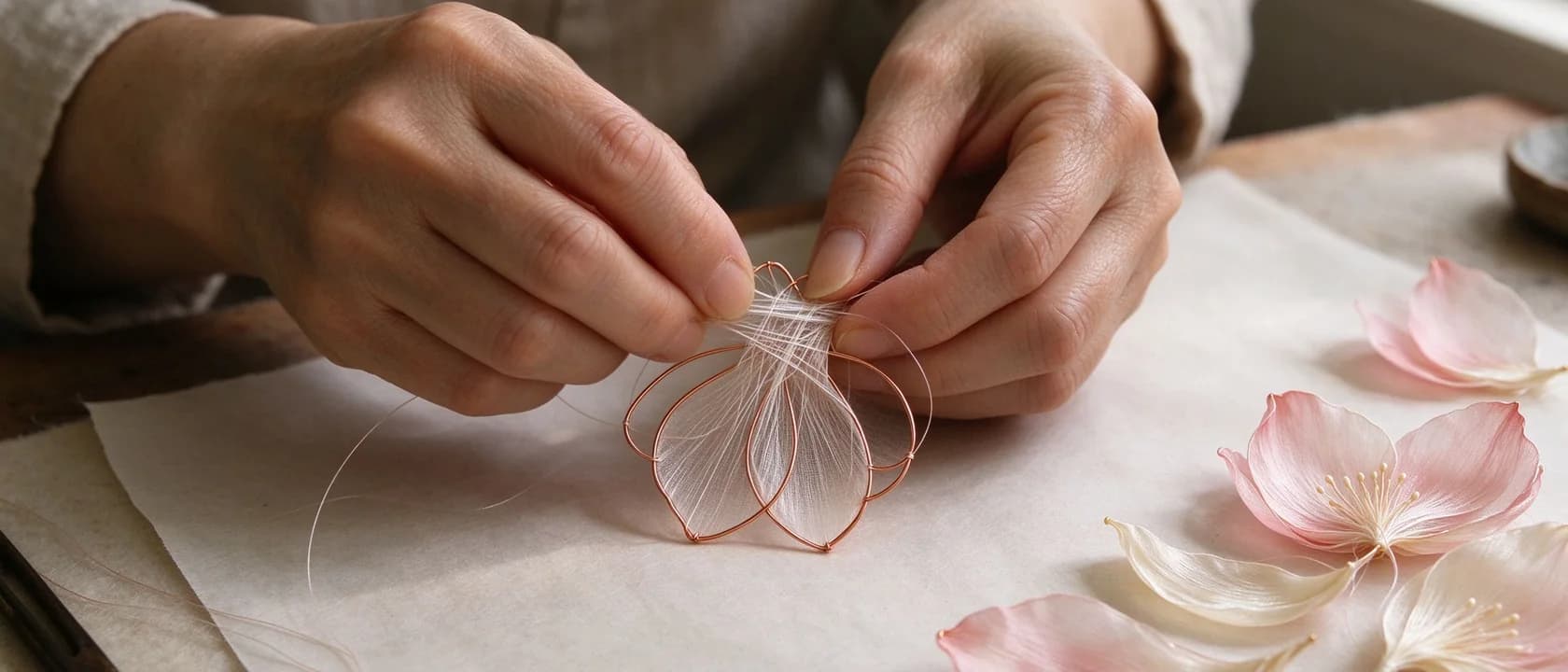
Silk behaves differently. The flowers in this shop are made by winding dyed silk floss around shaped copper wire, petal by petal, which is the Chinese craft of chanhua. A simple piece takes four to six hours; the most complex pieces take closer to a month of evenings. That work is why the color sits in the silk rather than on it, and why a flower made this way still looks like a flower in its twentieth December rather than its first.
You can read more about the technique on the chanhua craft page.
Where do the flowers go?
Three placements do almost all of the work. Everything else is optional.
| Placement | How it is fixed | How many |
|---|---|---|
| The crown, in place of a star | Pinned to a ribbon loop tied at the top, or wired to the leader branch | One large flower, or three small ones in a fan |
| Through the middle third | Wire stem bent around a branch, close to the trunk | Three to five, in two clusters |
| The lower edge, where the eye lands last | Pinned to a branch tip, slightly under the foliage | One or two |
| Along a garland or a mantel swag | Stem twisted around the garland wire, every 30 cm | Three per meter |
The crown is the placement that changes a tree most, because it replaces the one object everyone expects to see. A single large flower at the top reads as deliberate; a cluster of three reads as a bouquet that happens to be standing up.
How do you attach one without damaging it?
Never glue a flower to a branch. Glue marks the foliage, it fails in a warm room, and it makes the flower unusable afterwards, which defeats the point of buying something that lasts.
There are two clean methods:
- Ribbon loop. Tie a narrow ribbon around the branch, leaving a small loop. Pin the brooch through the ribbon. The pin never touches the tree, and the ribbon disappears into the foliage.
- Wire stem. Bend the stem ninety degrees, hook it over the branch, and twist the end back on itself. This is the method for a flower with a long stem, and it holds a heavy piece without sagging.
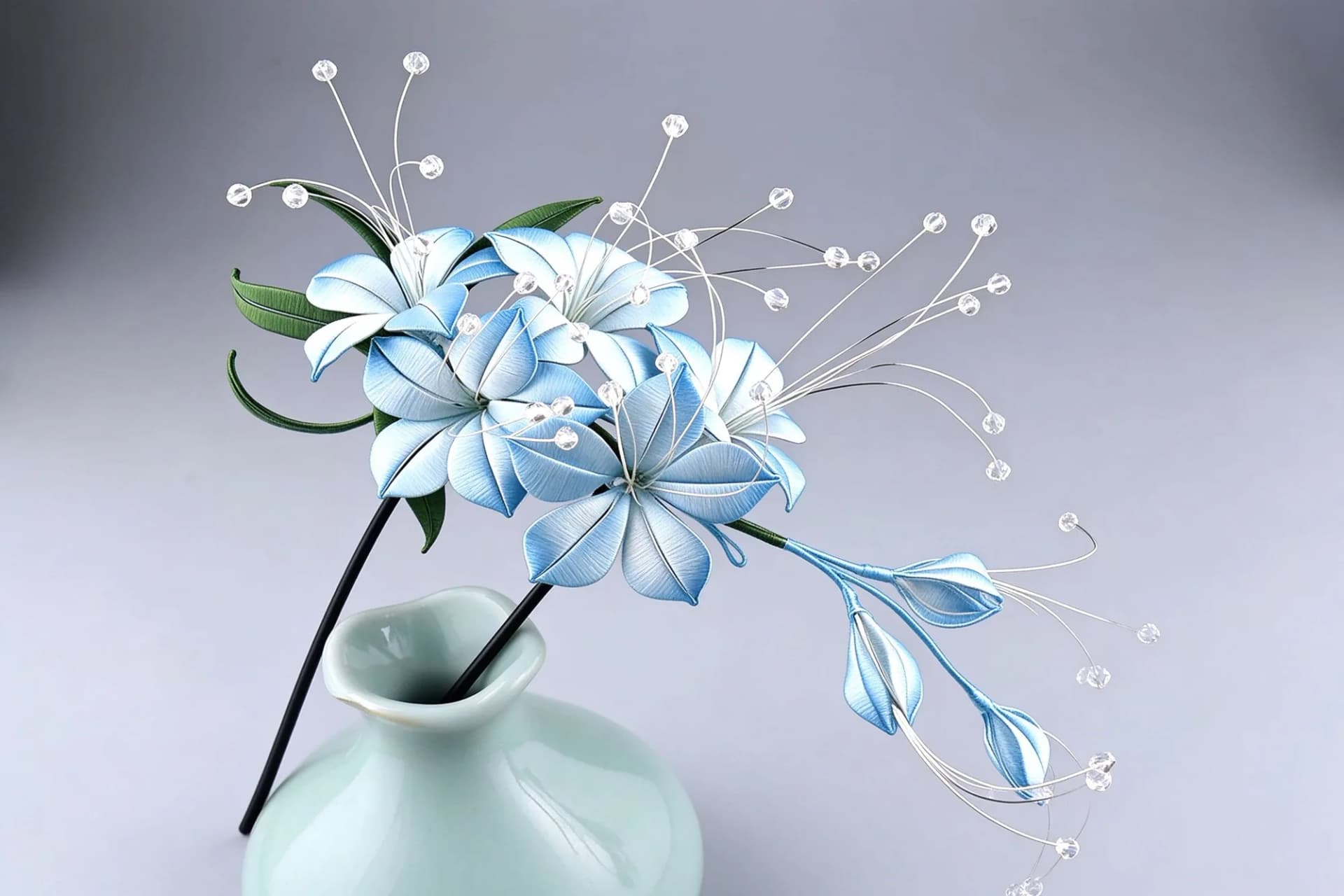
If the flower is a hairpin, hang it by the metal pin rather than by the tassel or the chain. A piece hung from its decorative parts will slowly pull itself apart over three or four weeks; hung from the pin, it is fine.
What color should the flowers be?
Two colors and one accent, at roughly 70 / 25 / 5. One dominant color carries the tree, a second color supports it, and a small amount of a third keeps it from looking like a set.
The mistake to avoid is a flower in a different color temperature from the lights. Warm white lights at around 2700K make cool silver and blue flowers look grey; cool white lights make warm red and gold look orange. Pick the flower after the lights, not before.
For a first tree, a deep red with a small amount of gold reads as Christmas from across a room. A pale pink or ivory flower is the more interesting choice, because it looks like something that came out of a jewelry box rather than a decoration box - but it needs the tree to be quieter underneath it.
How many is too many?
One cluster per 30 cm of visible branch front is the ceiling, and most trees look better below it. Clusters work in odd numbers - three, five - and they should sit at different heights, not in a line.
Leave gaps. A tree where the flowers are evenly spaced reads as a pattern; a tree with three distinct groups reads as a decision. The same rule applies to lights and baubles, which is why the trees in shop windows look expensive and the trees in catalogues look busy.
What do you do with them in January?
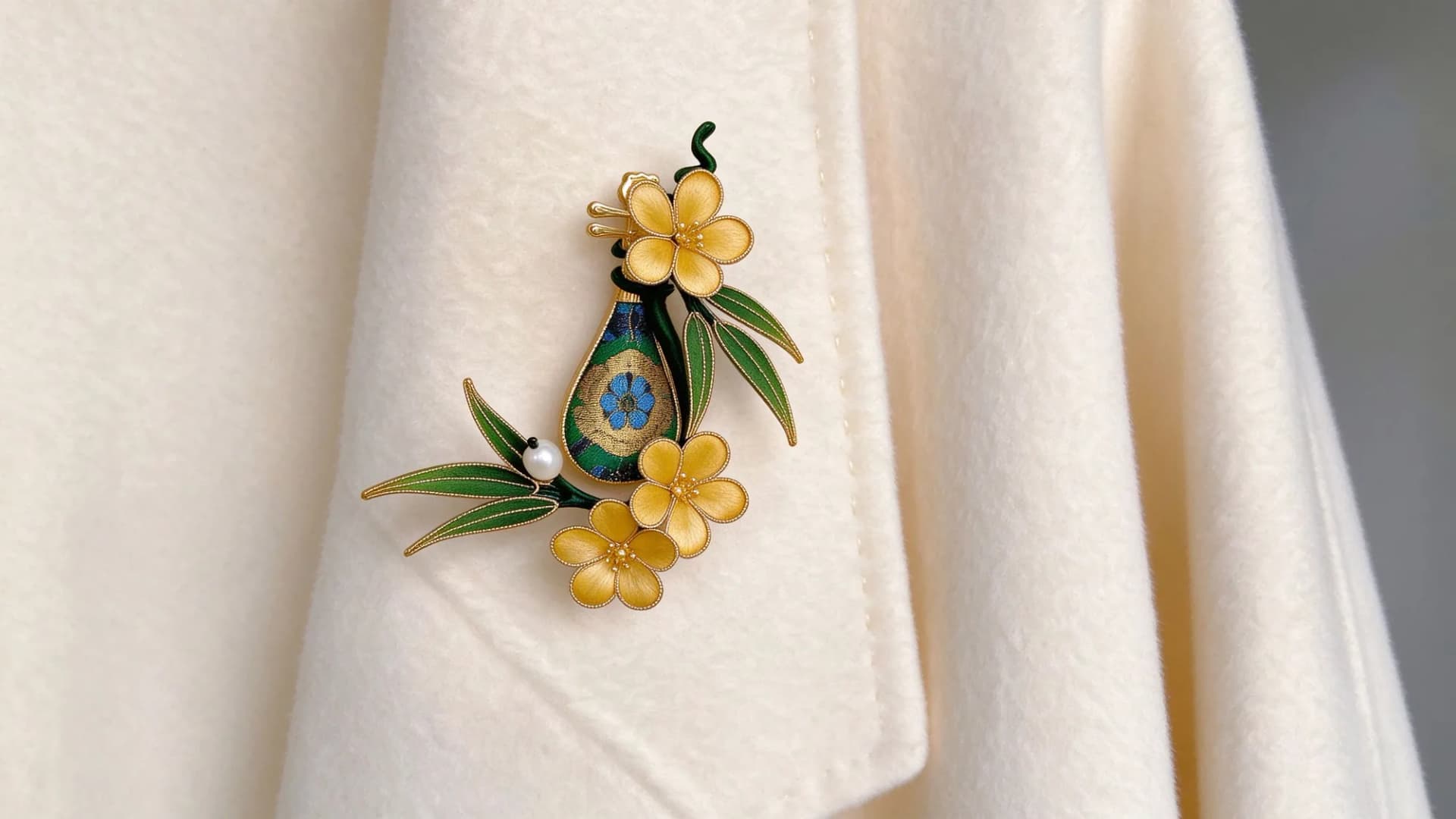
They go back to being worn. This is the practical argument for using jewelry rather than ornaments: a red silk phoenix on a coat lapel in February, or a hydrangea hairpin at a winter wedding, is the same object that was on the tree in December. The phoenix brooch and the hydrangea hairpin are both made to be worn, not stored.
Storage is simple: tissue paper, a rigid box, a dry cupboard, no direct sun. Silk floss holds dust on the surface rather than in the fiber, so a soft brush is enough. Do not seal a piece in plastic while it is still warm from a room, and do not hang it in a damp cellar for eleven months.
If you are deciding between making a piece yourself and buying one finished, the difference is covered in DIY kit or finished piece - the short version is that a kit is a winter evening and a finished piece is the result of one.
What should the rest of the tree look like?
Quieter than the flowers. Two materials at most - glass and silk, or wood and silk - and one metal. A tree that combines tinsel, beads, ribbon, flocking and flowers has no focal point left for the flowers to be.
The lights do most of the atmosphere. The flowers do the one thing lights cannot: they give the tree a place where the eye stops and looks at a made object rather than at a glow.
Where do silk flowers fit in a Christmas gift?
A flower that goes on a tree and then onto a coat solves the problem most Christmas gifts have, which is that they are used for two weeks and then put away. It is also the reason a single good piece beats a set of six: one flower gets worn, six flowers get stored.
If the tree in your house is the one everybody photographs, put the best piece at the crown where it will be in every picture, and let the rest of the tree stay quiet. That photograph is the reason the piece gets worn afterwards.
Frequently asked questions
How many silk flowers do you need for a six-foot Christmas tree?
Five to nine, in three clusters. A tree that is already full of lights and baubles does not need flowers spread evenly across it; it needs three places where the eye stops. More than nine and the flowers stop reading as jewellery and start reading as decoration.
Can you put a brooch on a Christmas tree?
Yes, and it is the easiest way to hang one. Tie a narrow ribbon loop around the branch, then pin the brooch through the ribbon rather than through the branch. The pin never touches the tree, and in January the brooch goes back on a coat.
Will a hairpin work as a tree decoration?
It will, but hang it by the pin, not by the tassel or the chain. A hairpin hung from its decorative parts will slowly pull itself apart under its own weight over three or four weeks; hung from the metal pin it is fine.
Do silk flowers fade on a tree?
Not from the light of a tree in a normal room over one season. They fade from direct sun over years, which is why the box they are stored in matters more than the month they spend on the tree.
Can I use real fresh flowers on a Christmas tree instead?
You can, and they look wonderful for about four days. A tree stands in a heated room for a month, which is the one condition fresh flowers handle worst. Silk is the material that survives the whole season and the next twenty.