How to Tell Handmade Silk Flowers From Machine-Made (7 Checks)
How do you tell a handmade silk flower from a machine-made one?
Turn it over. A hand-wound flower has a wire edge under the silk, visible thread lines following the wrap, and a back that shows how it was bound. A machine-made one has a flat or heat-sealed edge, a printed or molded surface, and a glued backing. Six of the seven checks below take about ten seconds.
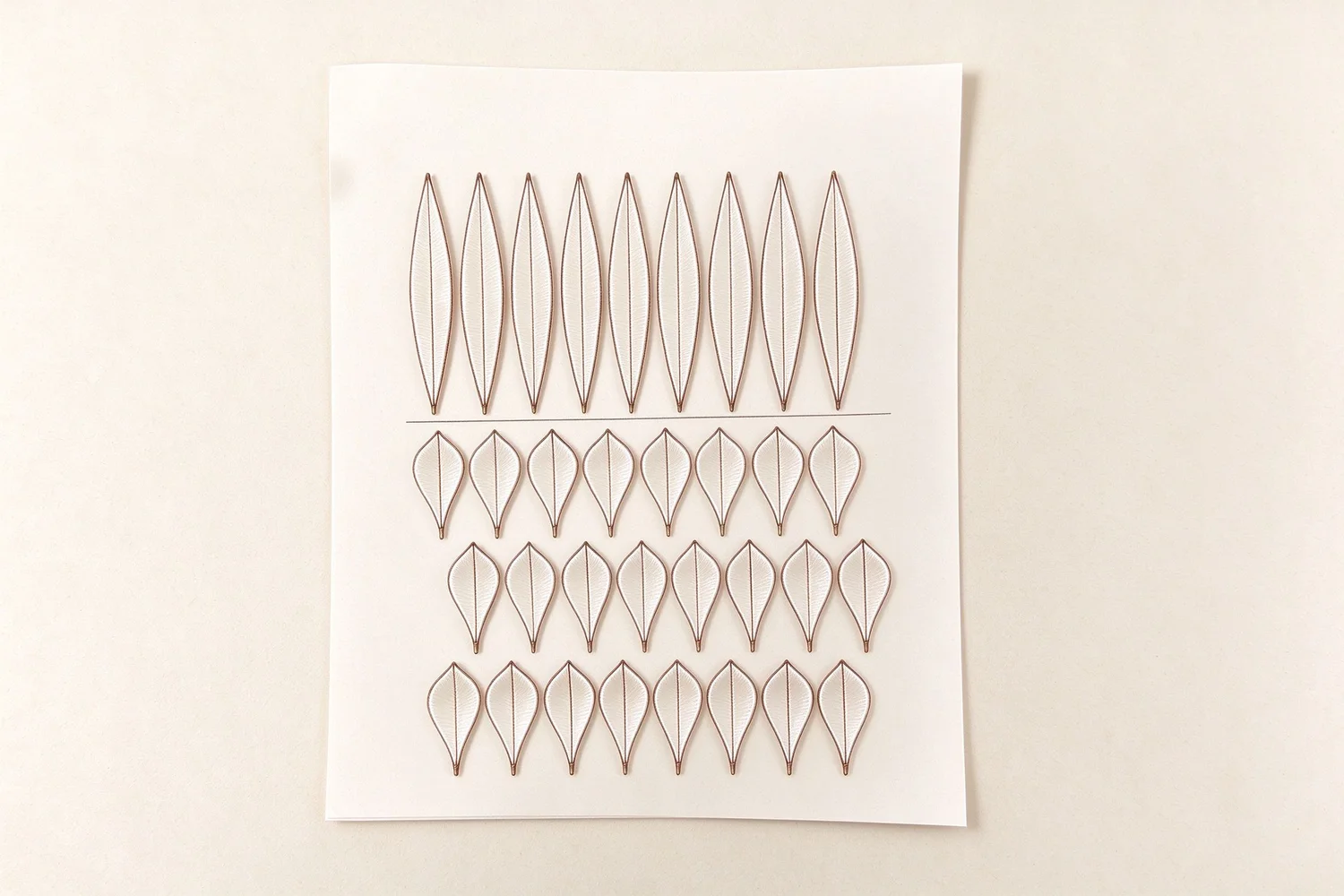
This matters more for silk flowers than for most things, because the price gap between the two is enormous and the vocabulary on listings is loose. "Handmade" can mean anything from wound petal by petal to assembled by hand from factory parts. Here is how to tell which one you are looking at.
The seven checks
| # | Check | Handmade | Machine-made |
|---|---|---|---|
| 1 | Thread lines on the petal | Visible, following the wrap | Printed or molded, no lines |
| 2 | Petal edge | Wire under the silk, rounded | Folded, sealed or cut flat |
| 3 | The back of the piece | Binding, wire, wrapped stem | Flat backing, glue |
| 4 | Petal-to-petal variation | Slight differences | Identical, or nearly |
| 5 | The flower center | Finished — stamens, a bead, a wrap | Glue blob or plastic disc |
| 6 | Flex test | Holds the curve you give it | Springs back flat |
| 7 | Price | Reflects hours | Reflects materials and tooling |
1. Look for thread lines
This is the fastest check and the most reliable.
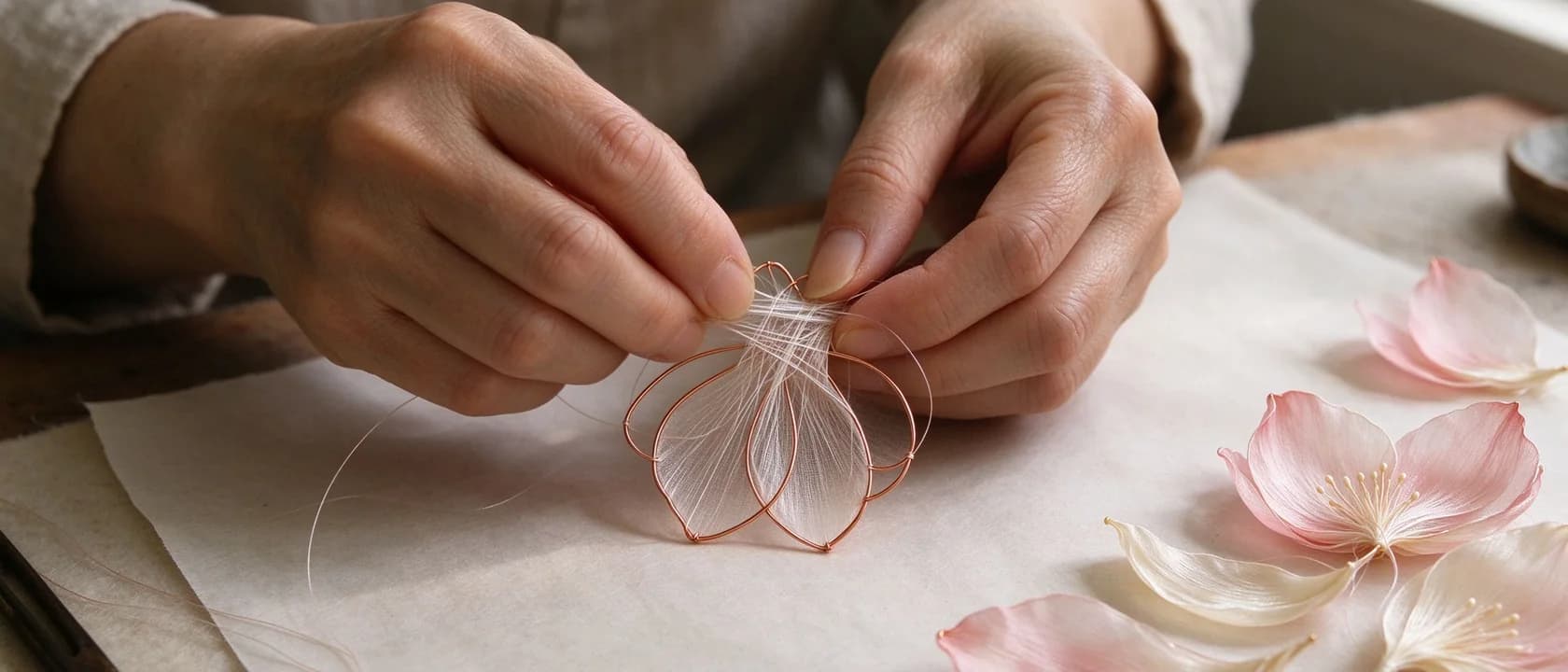
Hand-wound silk is wound strand beside strand around a wire frame. The surface is made of those strands, so it catches light in fine parallel lines that follow the shape of the petal. Tilt the flower under a lamp and they appear immediately.
A machine-made petal is a piece of fabric — printed, dyed, or a synthetic sheet — cut to shape. It has a weave, but it does not have wrap lines, and it reflects light evenly across the whole surface.
2. Feel the edge
Run a fingertip along the edge of a petal, gently.
On a hand-wound flower you can feel the wire inside the silk: a firm, continuous edge, slightly rounded where the thread passes over it. On a machine-made flower the edge is either folded under and stitched, heat-sealed into a hard line, or simply cut.
3. Turn it over
The back tells the truth, because it is the side nobody photographs.
A hand-wound piece has a back with visible structure: the wire outlines, the thread that binds the petals to the stem, the point where the ends were sealed. It is not pretty, but it is legible.
A machine-made piece usually has a flat felt or plastic backing disc, or a smear of hot glue holding the layers together.
4. Compare two petals
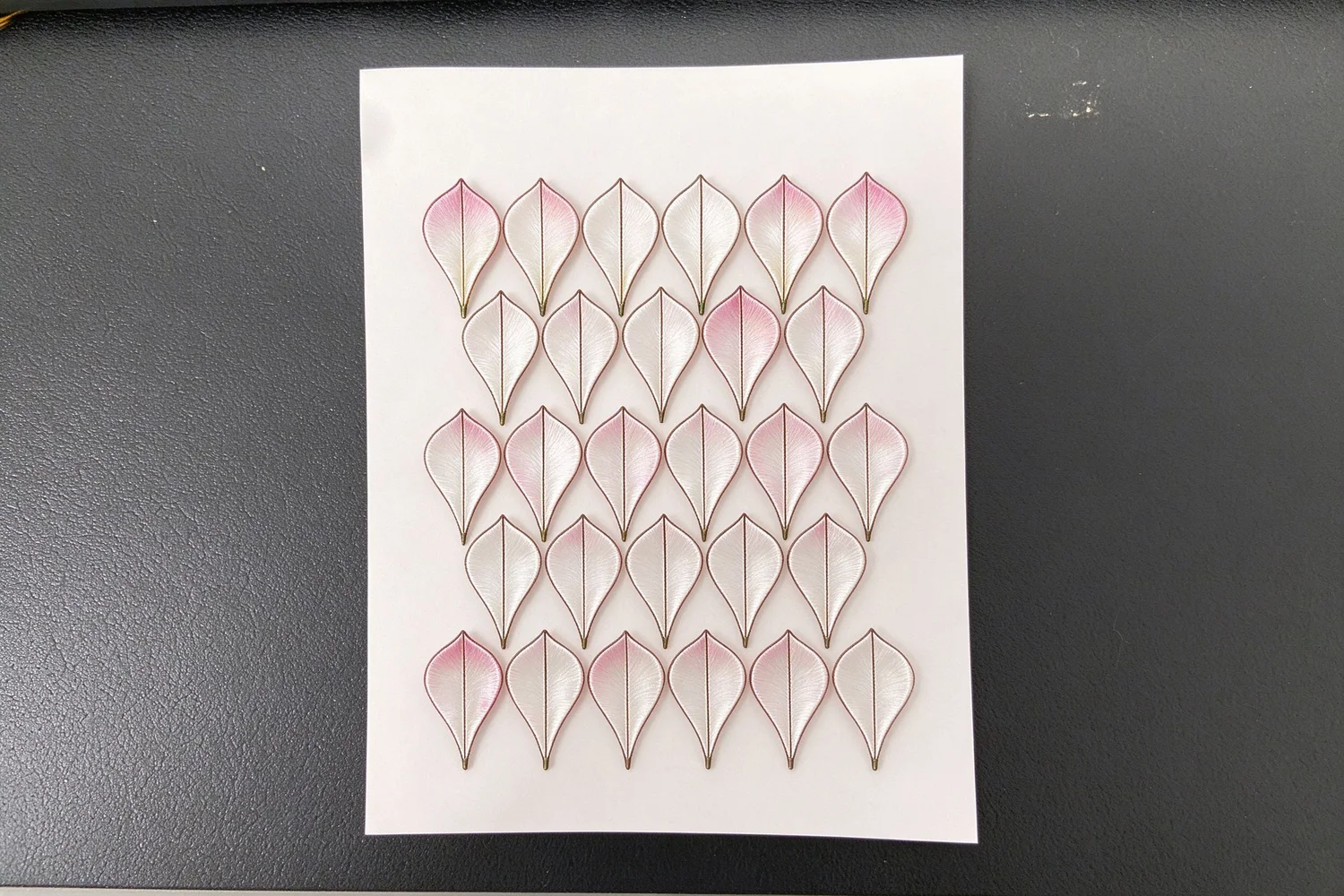
Hand-wound petals are made one at a time, so they vary: a fraction of a millimeter different in width, a slightly different curve, a thread that sits a little higher.
That variation is the signature. If every petal in a bloom is exactly the same shape, they were cut from a pattern — which is fine, but it is not hand-winding.
5. Look at the center
The center is where cheap work is usually abandoned.
A hand-wound flower finishes the center: pearl stamens, a bead, a small wrapped knot. It has to, because the petals meet there and the join would otherwise show.
A machine-made flower often has a visible glue blob, a plastic disc, or nothing at all once you look closely.
6. Flex a petal
Press a petal gently into a curve and let go.
Wrapped silk holds the shape you gave it, because the thread and wire take a set. Printed fabric springs back to flat, because the fabric has no memory of the curve.
This is also the check that tells you whether the piece will survive being worn. A petal that will not hold a curve will not hold up to a bag or a coat collar either.
7. Follow the price
The least romantic check and the most reliable.
A small hand-wound hairpin is four to six hours of work, and the most complex designs take about a month. Silk and wire cost very little; the hours are the object. That is why a genuinely hand-wound piece cannot be sold for the price of a machine-made one — the arithmetic does not allow it.
If a listing claims handmade winding and the price is a tenth of what the hours imply, one of the two claims is wrong. Usually it is "handmade".
The breakdown of where the hours go makes the arithmetic concrete, if you want to check a listing against it.
What machine-made flowers are actually good at
It is worth being fair here, because the comparison is not "good versus bad".
- Consistency. A hundred identical flowers for a stage set or a shop display.
- Price. A fraction of the cost, which matters when you need volume.
- Cleaning. Wipe it, and it is clean. Silk needs care.
- Color range. Printed fabric can be any color at no extra cost.
Machine-made is the right answer for a great many uses. It is simply a different product, and the problem only starts when the two are sold as if they were the same thing.
What should you ask a seller?
One question, asked plainly:
Are the petals wound by hand around wire, or are they fabric petals assembled by hand?
Both are legitimate. A seller doing the first will answer immediately and usually in detail; a seller doing the second will often answer with the word "handmade" again. The artisan page shows what the first one looks like in practice, and what chanhua is explains the technique itself.
Where does this leave you as a buyer?
If you want something to wear, and you want it to still look right in two years, the checks above are worth ten seconds of your time.
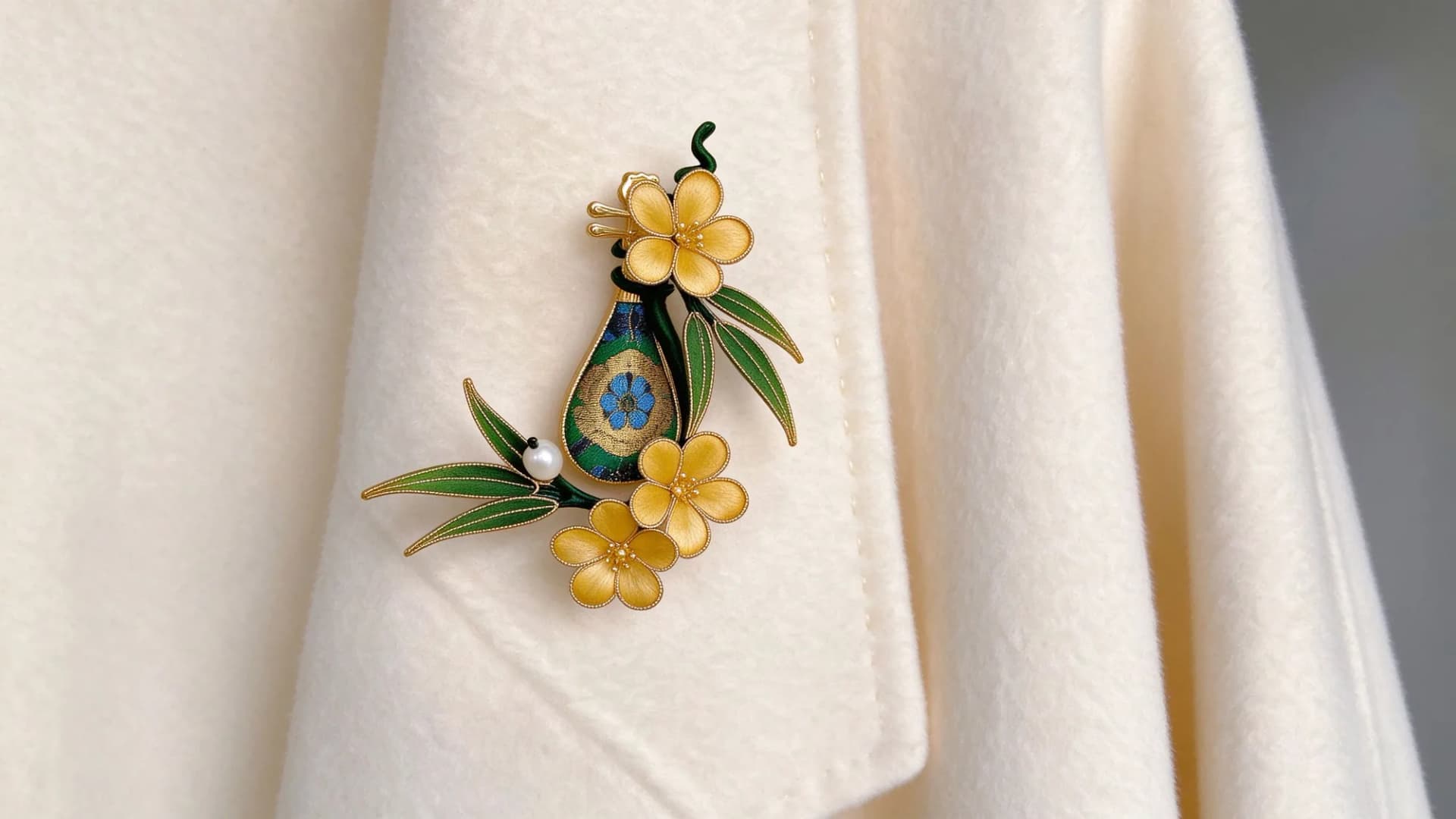
If you want to see the difference for yourself, the Blue Phoenix Brooch Kit is the most sculptural piece we make and the easiest to inspect — the feathers are long enough to show the wrap clearly. The Lily of the Valley Brooch Kit is the smallest, and the Hydrangea Hairpin Kit is the quickest first build. Each is wound by hand in our studio in Guang'an, Sichuan, and every one of the checks above will pass on a real one — which is the only test that matters.
Frequently asked questions
How can I tell if a silk flower is handmade?
Turn it over and look at the petal edge. A hand-wound flower has a wire edge under the silk and visible thread lines following the wrap; a machine-made one has a flat, folded or heat-sealed edge and usually a glued backing.
Are machine-made silk flowers bad?
No. They are consistent, inexpensive and easy to clean, and for a stage prop or a large decoration that is the right answer. They simply cannot be compared to a hand-wound piece on price, because one represents minutes and the other represents hours.
Why is a handmade flower so much more expensive?
Because of the hours. A small hand-wound piece takes four to six hours of work, which no factory price can absorb. The material cost of silk and wire is modest; the labour is the price.
Can a machine-made flower look handmade in photographs?
At a distance, sometimes. Up close, the two are not close: hand-wound petals have a woven surface that catches light in lines, and machine petals have a printed or moulded surface that reflects light evenly.
What if the listing says handmade but the price is very low?
Then it is probably assembled by hand from machine-made parts, which is a different claim. Ask specifically whether the petals are wound by hand around wire. A seller who does that will answer without hesitating.