Can You Fix a Bent Silk Flower? What Actually Works
Can you fix a bent silk flower?
Yes, for almost everything that happens in a box. A hand-wound flower is wire and silk, and both can be eased back into shape with fingers, patience and a little steam. What cannot be fixed is torn silk or a cut petal — those are replaced, not repaired.
The distinction matters because the wrong repair is worse than no repair. Glue, an iron, or a quick hard pull will turn a bent flower into a permanently damaged one in a few seconds.
What kind of damage can be repaired?
| Damage | Fixable? | What to do |
|---|---|---|
| Stem or wire bent | Yes | Straighten in small increments with your fingers |
| Petal bent at the base | Yes | Support the base and ease the petal back |
| Whole flower flattened in a box | Usually | Steam briefly, shape while warm, dry flat |
| Bead or center loose | Yes | Re-sew with matching thread |
| Petal torn | No | Replace the petal |
| Silk discolored or stained | Rarely | Do not bleach; consider a replacement |
| Glue already applied | No | Glue cannot be undone without damage |
If you have just opened a parcel and the flower is squashed, stop before you start. Take two photographs first — one of the piece, one of the packaging. That is what a shop needs if the damage happened in transit.
What do you actually need?
Four things, and none of them is a tool you have to buy.
| Item | Why |
|---|---|
| Your fingers | Most reshaping is done by hand, not with pliers |
| A small flat pliers | Only for a wire that has a hard kink, never for the petals |
| A kettle or a steamer | Two or three seconds of steam relaxes a flattened petal |
| Tissue paper and a flat box | The flower must dry in the shape you just gave it |
Do not use an iron, a hair straightener, a lighter, or glue. All four appear in online advice, and all four damage the piece.
How do you reshape the wire?
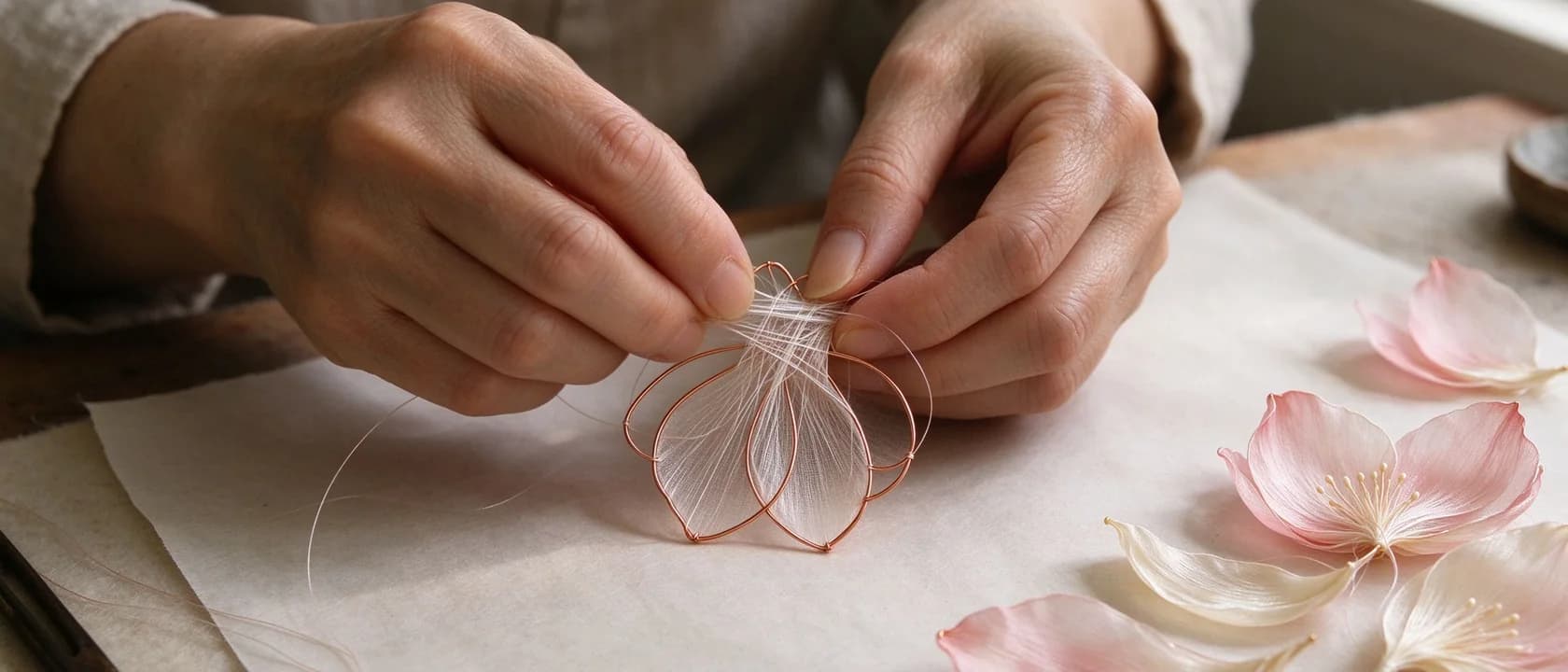
Find the wire by feel before you bend anything. On a chanhua piece it runs along the edge of each petal and down the stem; on a ronghua piece it sits inside the corded body. Once you know where it is, hold the flower on either side of the bend and move the wire a few degrees at a time.
The rule is small increments. A wire bent back in one movement usually kinks at the fold, and a kink cannot be removed — the metal has already changed shape at that point.
If the wire is a hard kink rather than a curve, use flat pliers to hold the wire just beside the kink so the pressure stays on the metal and not on the silk, then straighten slowly. Never grip a petal with pliers.
How do you fix a flattened petal?
Hold the petal at its base, not at the tip. The base is where the wire and the binding are, so it can take gentle pressure; the tip cannot.
Then bring the petal back toward its curve in small steps, checking the shape against the other petals as you go. A flower is symmetrical, and your eye will tell you when one petal is doing something the others are not.
If the silk itself is creased rather than the wire bent, move to steam.
How should you use steam?
Fill a kettle, bring it to steam, and hold the flower about fifteen centimeters away for two or three seconds. Not over the spout, and not for longer. Silk takes steam well; silk takes heat badly.
While the petal is warm and slightly relaxed, shape it with your fingers and lay the flower flat on tissue paper to dry in that position. Do not hang it while it dries — gravity will pull the warm silk back out of shape.
Test on one petal first. If the color looks dull or the surface changes, stop and let the piece dry; most silk recovers, but it is not worth risking a whole flower on the first attempt.
What makes a repair worse?
Three things, and they are all quick.
Glue. It stiffens the silk, dries shiny, and cannot be removed. A loose petal should be re-bound with thread, which is how it was attached originally.
Heat. An iron flattens the wrap and can scorch. A hair dryer on hot will blow the fibers apart.
Pulling. A petal that resists is usually held by wire and thread, and force moves the problem into the binding.
If a repair is not working after two attempts, stop. A small bend left alone is invisible at arm's length; a petal that has been worked too many times is not.
How do you stop it happening again?
Store the piece flat, in a rigid box, with tissue supporting any long stem or tail. The failures we see most often are not from wearing the flower — they are from a flower loose in a handbag or a drawer with other jewelry on top of it.
The storage method is the same one used for shipping, and it is set out in how to care for chanhua and ronghua. If you are posting a piece to someone else, how to wrap a handmade brooch covers the packing that prevents most of this in the first place.
Which pieces are easiest to repair?
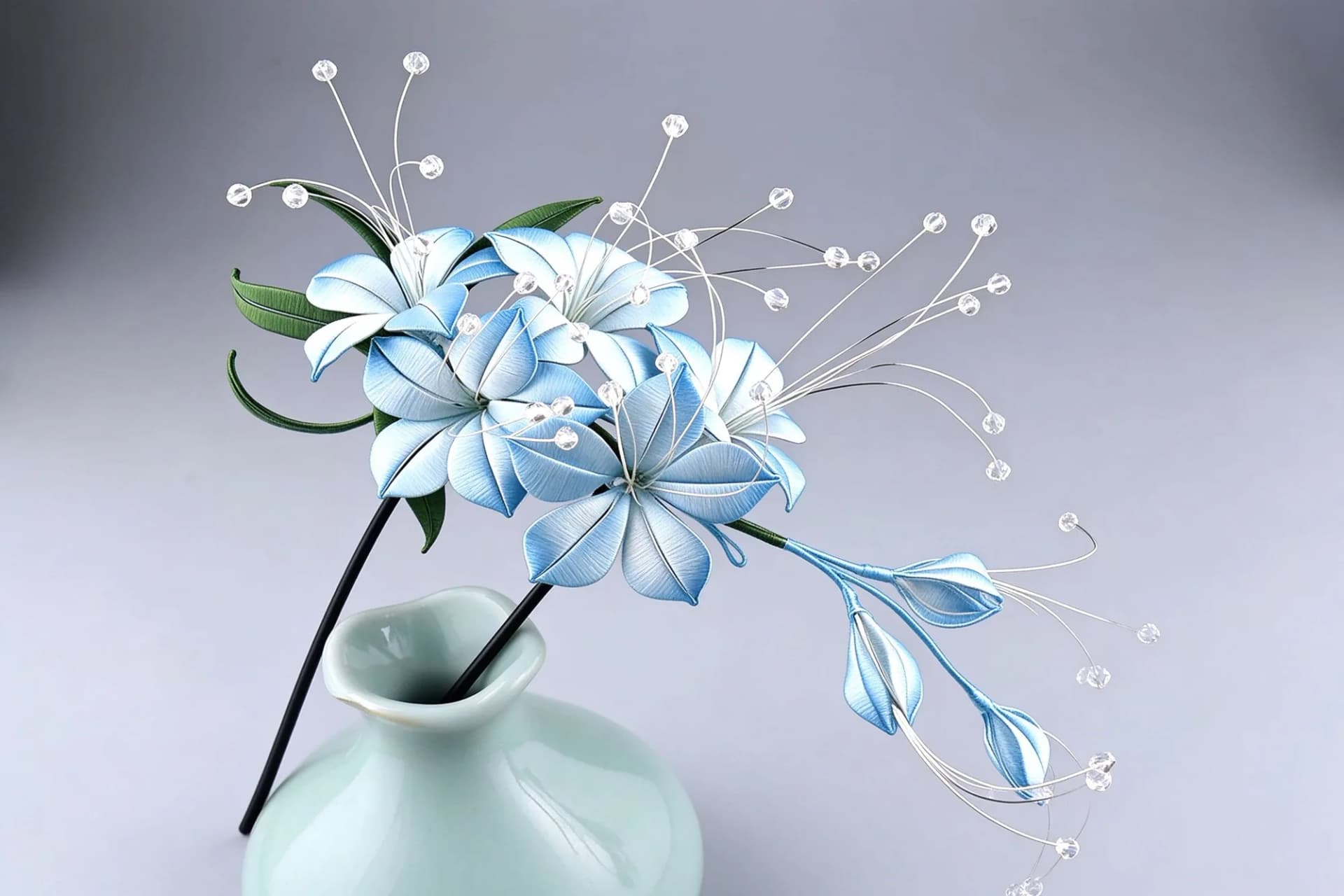
Pieces with an exposed wire edge, such as the lily of the valley brooch, are the easiest, because you can see the structure you are correcting. A dense cluster, such as the hydrangea hairpin, is harder because the petals support each other and moving one moves its neighbors.
The phoenix brooch sits in the middle: the body is forgiving, but the tail is the part that takes the damage, and it is also the part that shows.
When is a repair not worth it?
When the silk itself has failed. A torn petal, a stain that has gone into the fiber, or silk that has been crushed flat and steamed twice without recovering — none of these come back, and continuing to work the piece only makes the damage more visible.
That is the honest limit of a handmade object: it can be maintained for years, but it cannot be restored to new. The chanhua craft page explains how the silk is wound, which is the reason a bent piece is usually recoverable and a torn one is not.
Frequently asked questions
Can a crushed silk flower be fixed?
Usually, yes. A flower that was flattened in a box is mostly wire and silk that has been pushed out of shape, and both can be eased back. A petal that is torn, or silk that has been cut, cannot be rejoined — that one is replaced.
Can you iron a silk flower?
No. A hot iron flattens the wrap that gives the petal its surface, and it can scorch the silk. Steam from a kettle held at a distance is the only heat that belongs near a hand-wound flower.
Should you glue a petal back on?
No. Glue stiffens the silk, shows as a shiny patch, and fails the next time the piece is worn. A petal that has come loose at the base is re-bound with thread, which is how it was attached in the first place.
How long does it take to reshape a flower?
Ten to twenty minutes for a small piece, plus drying time. Work slowly and in small increments — most damage done during a repair comes from someone trying to fix a bend in one movement.
What if the flower arrived damaged in the post?
Photograph it before you touch it, then contact the seller. Once you start reshaping, it is no longer possible to tell transit damage from wear, and most shops cannot accept a claim after that.