Ronghua Birds: Velvet Flowers Made as Animals
What is a ronghua bird?
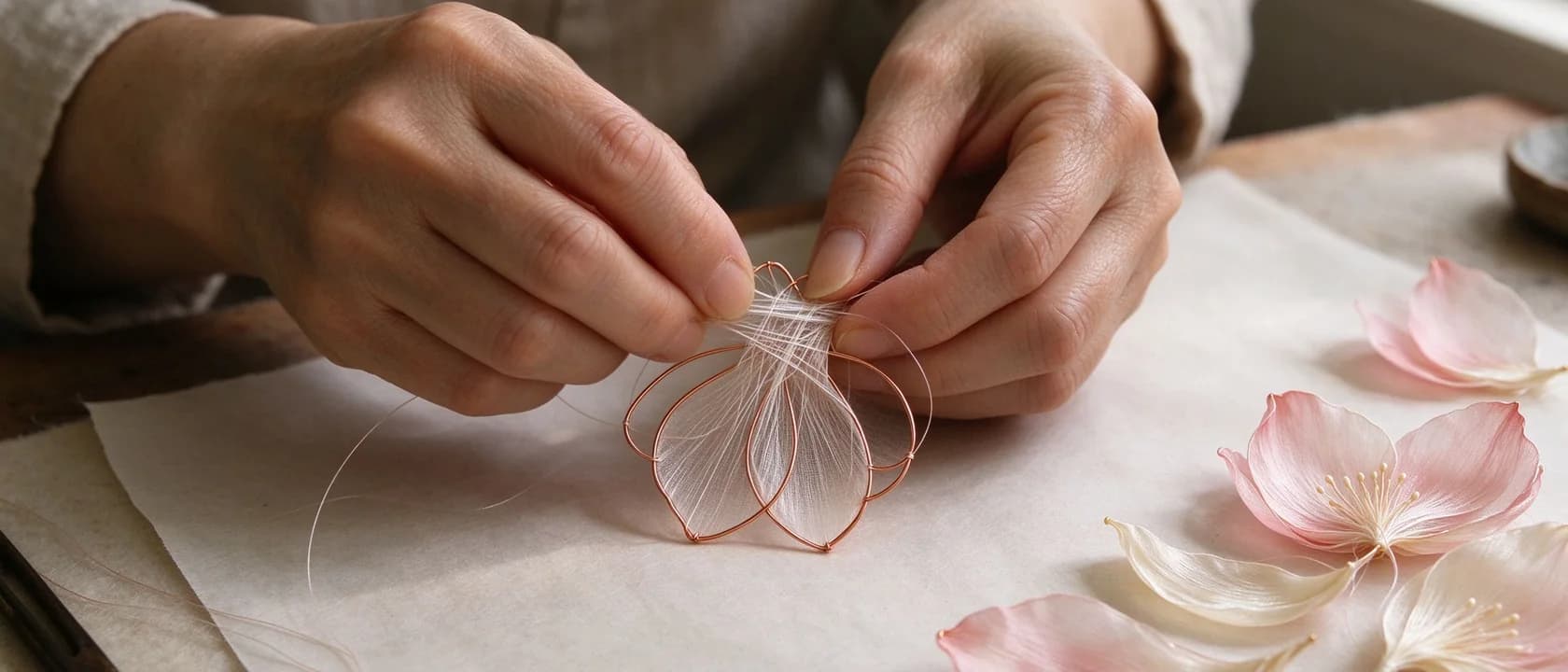
A small animal built from twisted silk cord over a copper-wire frame - the same craft as a ronghua flower, pointed at a harder subject. Where a flower is a rosette with one good side, a bird has a beak, a back, a tail and a belly, and it has to look like a bird from every angle it can be turned to.
That is why bird figures are the piece makers use to judge each other. Anyone can make a flower read at arm's length. A bird shows whether the maker can hold a proportion, because the eye checks a bird against a real bird without being asked to.
Where does ronghua come from?
Nanjing is the city most closely associated with the craft. It is recorded from the Tang dynasty, and by the Qing it had become court headwear: velvet flowers and small velvet animals were worn in the hair at festivals and weddings, and a woman's rank and the season both showed in what she wore.
The technique survived the twentieth century in a handful of workshops and is now listed as intangible cultural heritage in Jiangsu. Most of what is sold today as ronghua is floral; birds and animals are the smaller, older branch of the craft, and they are harder to find because they take longer to build and cannot be flattened for shipping.
The wider history is on the ronghua craft page.
How is a ronghua bird made?
Four stages, and the first one decides whether the bird will hold its shape at all.
| Stage | What happens | What can go wrong |
|---|---|---|
| The frame | Copper wire is bent into the body, wings and tail | Wire too soft - the bird sags within a year |
| The cord | Boiled silk is twisted into a dense, velvet-like cord | Cord twisted too loosely - the surface goes fuzzy |
| The trim | The cord is cut and shaped so the body tapers at the neck and tail | Cut too bluntly - the bird reads as a ball |
| The assembly | Body, head, beak, eyes and tail are joined and combed into direction | Assembled flat - the bird has no volume from the side |
The trim is where most of the character lives. A bird's body is not a sphere: it narrows behind the head, widens at the breast, and tapers into the tail. A maker who trims evenly produces something soft and round that photographs well and looks like a toy in the hand.
Why make a bird rather than a flower?
Three reasons, and the first is the honest one: birds were always part of the craft. Velvet animals were made alongside velvet flowers for the same reason - a festival headdress needed movement, and a small bird on a spring moves when the wearer does.
The second is symbolic. In Chinese decoration a magpie stands for joy, a crane for long life, a swallow for spring arriving, and a pair of birds for a marriage. A flower can carry a season; a bird can carry a wish.
The third is technical. A bird forces the maker to work in three dimensions, which is the skill that separates a competent flower from a good one. If you want to see whether a workshop is actually making things rather than assembling them, ask for a bird.
How is it different from chanhua?
The materials look similar and the two crafts are often confused, but the construction is opposite.
| Chanhua | Ronghua | |
|---|---|---|
| Silk form | Flat floss, wound around a petal frame | Twisted cord, bound into volume |
| Structure | Petals on a stem, mostly two-dimensional | A body built from several corded parts |
| Surface | Translucent, catches light in lines | Dense and matte, like velvet |
| Typical subject | Flowers, butterflies, hairpins | Flowers, birds, small animals |
| Failure mode | A bent petal shows a crease | Flattened cord never recovers |
The practical difference for a buyer is care. Chanhua tolerates being stored flat between sheets of tissue; ronghua does not, because the cord has pile and pile that is pressed stays pressed. The comparison in more detail is here: chanhua vs ronghua.
What should you look at before buying one?
Five things, in this order.
- The silhouette from the side. Turn it. A bird that only reads from the front was built flat.
- The join at the neck. This is where a rushed piece shows glue or a gap. On a good piece the cord changes direction smoothly.
- The tail. It should hold a line without a wire showing through the silk.
- The eyes. Beads set slightly into the head, not sitting on the surface like pins.
- The base. If it is a brooch or a hairpin, the finding should be sewn or bound, not glued to the cord.
Price follows the same logic as every other hand-made piece: hours, not materials. A bird is small and takes a surprising amount of time, which is why it costs more than a flower of the same width.
How do you wear or display one?
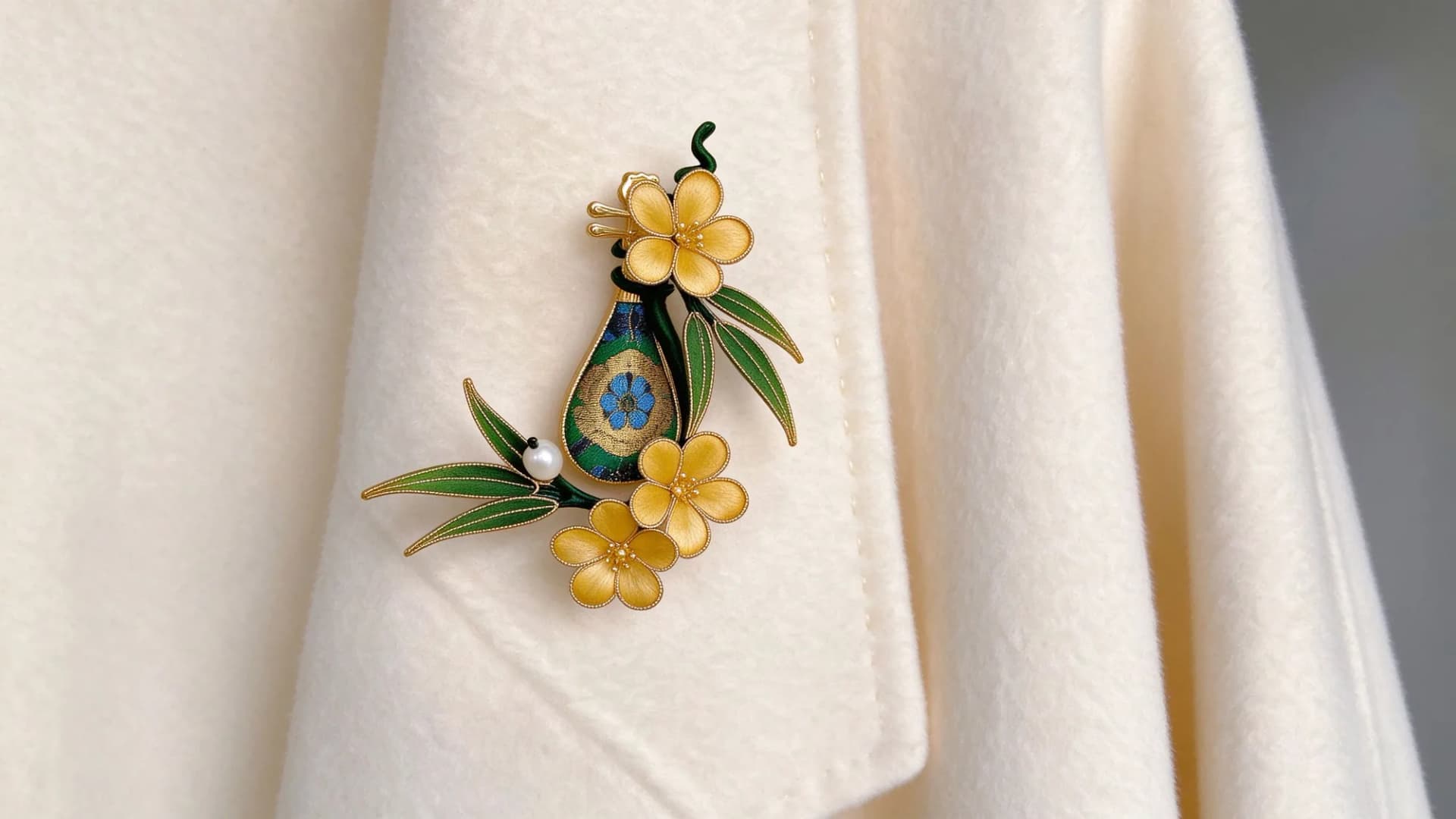
As a brooch on a wool coat, at the shoulder rather than the lapel, because a bird has a direction and should face away from the body. As a hair ornament, set low and to one side so the tail lies along the head rather than sticking out.
As an object, it belongs on a shelf at eye level with a plain wall behind it. A bird against pattern disappears, because the eye reads the pattern first and the silhouette second. The same rule that governs how to photograph a silk flower with a phone applies here: matte background, side light, no flash.
If the piece is a gift, pair it with something that explains it. A bird with no context is a cute object; a bird with a paragraph about Nanjing, the Qing court and the meaning of the species is a gift with a reason.
Which pieces in the shop are the closest relatives?
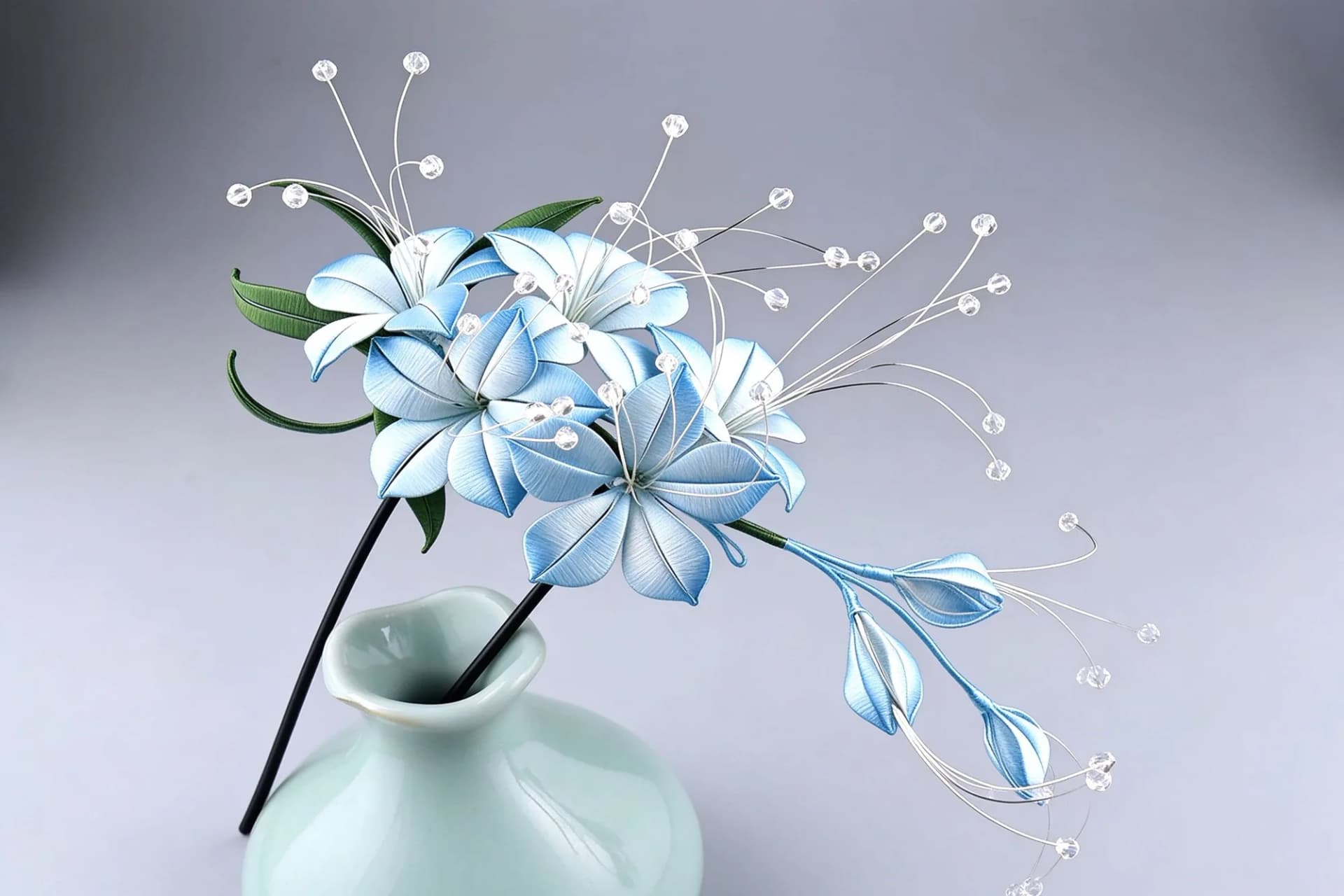
The bird is a ronghua form, and the shop's current work is chanhua, but the same instinct - an animal built petal by petal rather than molded - shows in the phoenix brooch, which is the most bird-like piece we make. The hydrangea hairpin and the lily of the valley brooch are the floral versions of the same technique.
If you are choosing between the two crafts as a buyer, the short version: chanhua for light and movement on a lapel, ronghua for density and a shape you want to hold.
Will ronghua birds be available here?
That is the direction the studio is moving, and pieces will be listed when they are ready rather than announced early. In the meantime, the ronghua craft page explains the technique, and ronghua hair flowers for hanfu covers how the floral version is worn.
The honest position on a bird: it is the piece that shows whether a maker can hold a form. Buy one because you want the form, not because it is small.
Frequently asked questions
What is a ronghua bird made of?
Twisted silk cord over a copper-wire frame. The silk is boiled and then twisted into a dense cord, the cord is bound onto wire, trimmed into shape and assembled. Nothing is moulded and nothing is printed, which is why two birds made from the same drawing are never identical.
Why are birds harder to make than flowers?
Because a bird has to read from every angle. A flower is a flat rosette with one good side; a bird has a beak, a tail, a back and a belly, and it has to hold its silhouette when it is turned. The proportions are also unforgiving - a beak a millimetre too long changes the whole expression.
Is ronghua the same as chanhua?
No. Both use silk and copper wire, but chanhua wraps flat silk floss around a shaped petal frame, while ronghua twists silk into a velvet cord and builds volume from that cord. Chanhua reads as a translucent flower; ronghua reads as a soft, dense object.
Where does ronghua come from?
Nanjing is the city most associated with it. The craft is recorded from the Tang dynasty and became court headwear in the Qing, when velvet flowers were worn in the hair for festivals and weddings. The technique is listed as intangible cultural heritage in Jiangsu.
How should a ronghua bird be stored?
In a rigid box, upright or on its side with tissue supporting the tail, away from damp and direct sun. The risk is not dust but pressure: velvet cord that is flattened in storage stays flattened, and a tail bent for a month will not come back straight.